
Somewhere around 11:30am yesterday I hit the road south, headed back towards the North Carolina State line -----
I had a massage appointment scheduled for 4:30pm ---and called home ((As soon as I reached a place where I had a phone signal!)) to let everyone know I was on my way.
Turns out --- there would be no one home to meet or greet me –Jeff was off with friends and DH was playing golf and wouldn’t be done until after 6pm.
Well, okay then! Why drive out of my way to go home and THEN back to town to make my massage appointment at all? No one would be there to miss me ----and I was in a BROWSING mood!
First off, let me say that I did NOT win my bids on either the juki sewing machine or the tiny cake stand/basket quilt – I was out bid on BOTH of those items –they went higher than I was willing to pay, but I feel good that I did my part to drive the value up for the winning bidders!
I suppose that was my impetus for wanting to wander and see “what else” I could find myself in trouble with.

Turkey Tracks!
I love the name “Turkey Tracks” better than I like the alternate name of “Devil’s Claw” The only thing I like with the word DEVIL in it is Deviled Eggs – and I’m not sure why that is called Devil anyway! Deviled eggs are HEAVENLY!
I love the blue and red alternating sashings in this one --- very fun! They wanted an awful lot of money for this one, and it wasn’t that old or in very good shape, and it had these black canvas headers machine stitched to the top and bottom ….who knows what for? But still ---

Some mighty fun blocks!
In fact, I want you to keep this block in mind --- I have a post coming up in about a week that will reflect back to this post, so just remember, I’m whetting your appetite here!

Another plaidy one! I do love the background fabrics mixed with those comfy plaids.

I rounded the corner to find…..THE GENERAL!
And all I could think of was the song from “White Christmas” with Bing Crosby ----
What can you do with a general
When he stops being a general?
Oh, what can you do with a general who retires?
Who's got a job for a general
When he stops being a general?
They all get a job but a general no one hires
Which would be about the right age for this General who is a Japanese Singer Knock-Off from around 1950 something!

No, The General didn’t come home with me either --- but his scrolled face plate is dang handsome, isn’t it? Something is funny in the world of antiques when they think a machine like this should sell for as much as a featherweight in mint condition. Sorry Sir, but you’ll have to be adopted by someone else!

There were some other machines --- toy ones!
I already have one of these, in much better condition --- but I still gave it’s hand crank a whirl! I would have loved to have had one of these when I was a little girl!
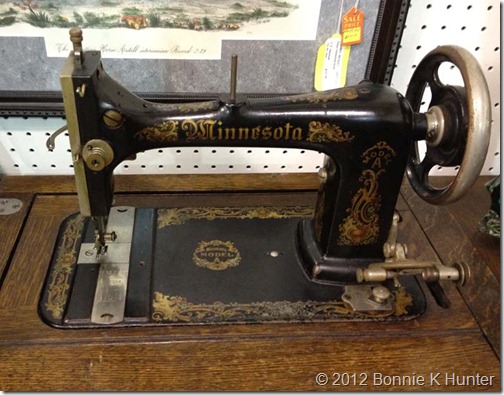
And the dream of having a Minnesota Treadle goes on ---but I don’t have room for it --- I’ve already got 3 treadles in the house. I petted her, gave her hand wheel a turn and moved on ---

Oh, this beauty! It’s a New Home with a gorgeous paint job….
The case was in pretty great shape too…but the price was high ----still – look at hat gorgeous decal work!
I am not sure if this was originally a treadeled machine – motorized later. Some of these with added motors don’t have belts…there are little bushing/bearing things attached to the motor that go right up against the hand wheel to turn it…..

And of COURSE there were more quilts! The color and motion in this one really caught my eye --- it’s a 1930s….but look at that ORANGE block! Someone loved color!

I laid it out on the floor to get a better look….what a fun quilt! The stars are string pieced on fabric foundation diamonds….there is a lot of bulk and “volcano” action going on within the blocks..
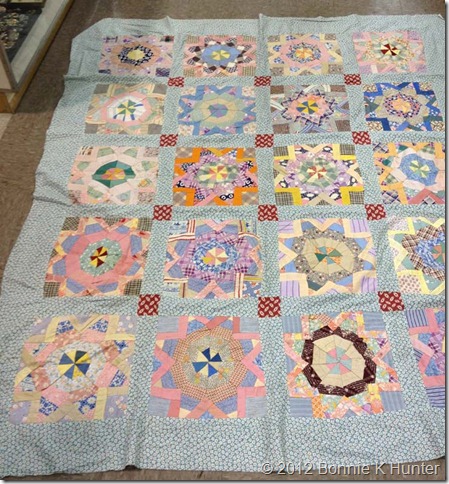
These borders wave like the wind!
Sometimes there is a really good reason why a quilt top was never quilted….can you say PLEAT PLEAT PLEAT three times fast?! But what great blocks!

Gotta love that orange!

BIG HONKIN’ CHECKS!
Are these “Dan River” plaids and ginghams?

These were just SO QUIRKY. It was fun to be able to take the time to appreciate the blocks and the creativity and free-spirited feel.

Other things I love --- stacking picnic baskets!
Picnic baskets are fairly inexpensive and highly versatile for quilters on the go --- they hold projects and fabrics and notions --- and look cute while doing so. If you find the kind with the moving handles, they can stack ---

I found this pretty old one……the wood is heavier split oak – it was in great condition. THIS ONE came home with me --- I love it!

THIS?!
Did NOT come home with me! LOL!
This is a “vintage” sea diver’s helmet ---and all I could think of when I saw it was the Scooby Doo episode with the Diver Ghost….”OH you MEDDLING KIDS!” No…..the diving helmet stayed there. So did THIS:
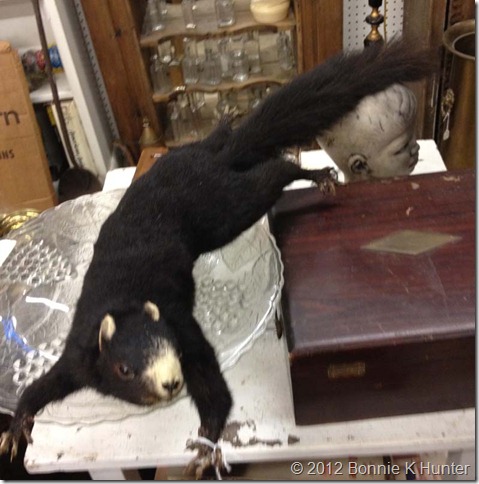
Taxidermied Vintage Black Tail Squirrel!?
No thank you!
I do get a big kick out of seeing what the “Wierdest” item of the day was …..and it is a toss up between the stuffed squirrel and the diving helmet ---

This quilt immediately calmed my hysterical laughter ----OOOOOOOOOOHHHHHH!
What a quirky tulip! I love the little buds beneath the big tulip bloom! And can you see all that echo quilting?
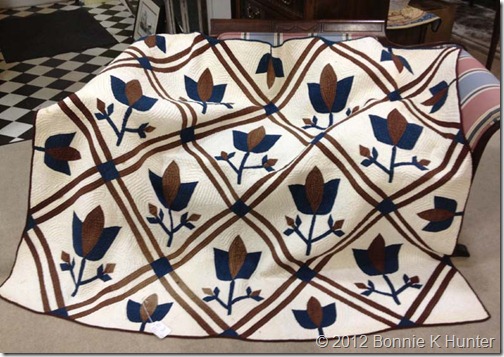
Look at the little buds in the setting triangles! I like the triple sashing too…..not to mention that “Ox blood and Teal” are just great antique colors! Did they used to be red and green?

This didn’t come home with me either. They wanted $400, which it could be worth, but I wasn’t willing to part with that sum quite so quickly ---
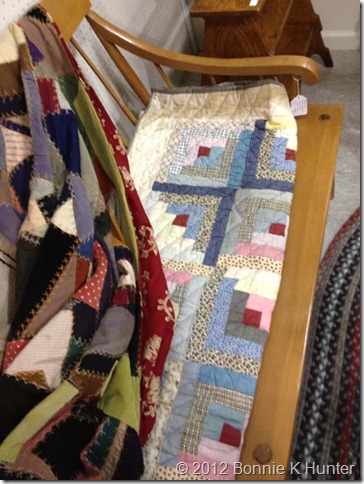
Log Cabins on benches….always nice!
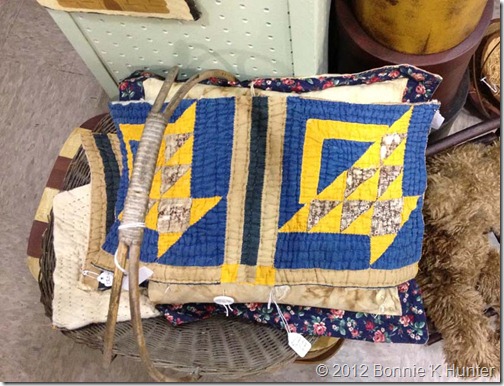
Golden Scrap Basket blocks…cutter pieces. CUTE! I love the blue background for the blocks..

One more cool old singer --- priced rather high for the condition it’s in ---this one would have needed a lot of work, and I prefer machines that use regular bobbins than bullet shuttles ---I also would rather have foot pedal controls than knee controls --- yes, I know I can wire on a foot pedal, but still ---- I did love the decal work on this one too – even if it has had a busy life and was probably used well and often!
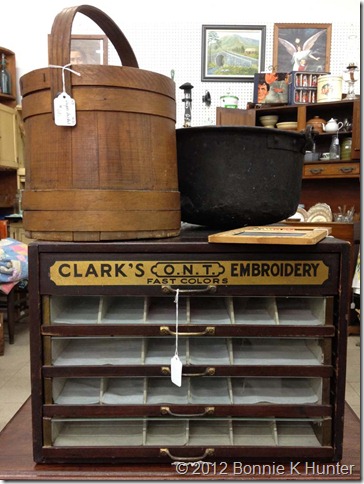
And then I saw it. What I’ve been looking for at a reasonable price for YEARS. A thread cabinet! This one was for embroidery floss in its day --- and it has glass fronts so you can see what is in the cubbies. I fell in love instantly.
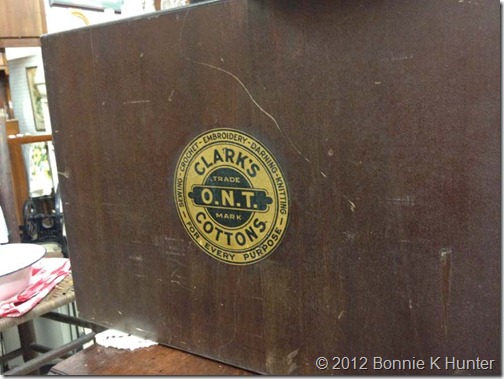
See the cool logo?!
After I made my purchase I floated my way to my massage! Of course, even the receipt says “CABINET” so I’m passing it off as necessary “Office Furniture”!
I’ve cleaned out some other storage caddies and drawers and placed things in the new cabinet in its new location – I'll get a pic later, there is still organizing going on….
I got my shopping fix ---and increased and improved upon my studio storage with the addition of the picnic basket and the thread cabinet. All in all, not a bad traveling day home!
And…..should you know of anyone who happens to be looking for antique diving helmets or stuffed black tailed squirrels --- I know just where you can find them!


